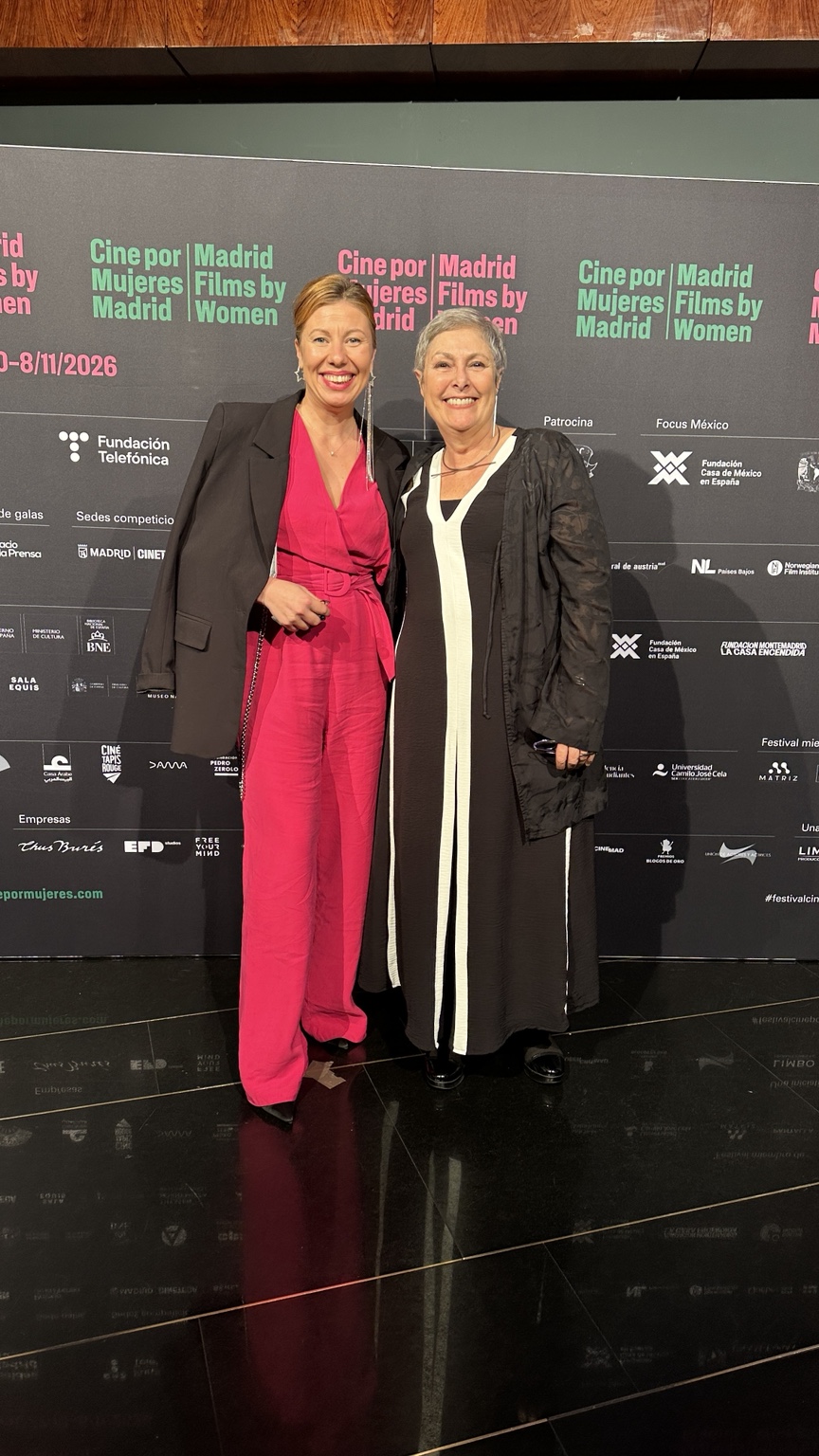
I went to the opening of Festival Cine por Mujeres Madrid to discover a film. I left thinking about who gets to decide which stories we see.
As a creative producer based in Madrid, building my professional life in Spain and across Europe, I am interested in the decisions that happen before a camera starts recording. Whose experience becomes a screenplay? Who recognises its potential? Who helps it reach an audience?
Those questions made this festival feel personal.
Its ninth edition ran from 27 October to 8 November 2026, presenting 67 films from 19 countries. But the significance of Cine por Mujeres Madrid is not simply the number of films it brings together. It is the space it creates for women to be recognised as authors, decision-makers and professionals behind the screen.
Carlota Álvarez Basso and the work of making women visible
One of the pleasures of the opening night was meeting Carlota Álvarez Basso, who co-founded the festival with Diego Mas Trelles in 2018.
What I value about her work is the shift in attention it makes possible: from women as subjects of the camera to women as the people deciding where that camera should look.
A woman can be the face on a poster. She can also be the person who chooses the story, builds the production, directs the actors, shapes the image or finds the rhythm in the edit. The difference is authorship.
For me, Carlota’s work matters because it gives that authorship a public space. It brings names, careers and perspectives into view, allowing audiences to discover filmmakers whose work they might otherwise never encounter.
“The difference is authorship.”— Sasha Alexeeva
This is not about claiming that women have only recently begun making art. Women have always created. What concerns me is the unequal opportunity to develop that work, have it preserved, receive recognition and become a reference for the next generation.
We inherit a cultural conversation in which male perspectives have often been treated as universal, while women’s perspectives are more readily described as a category.
I want to see what happens when women are given more room to develop their artistic language without having to justify why their experience deserves attention.
That is why I would love to see festivals like Cine por Mujeres Madrid gain even greater visibility, resources and international recognition. The ambition deserves a larger audience.
Esther García: production as a creative responsibility
The opening ceremony also honoured producer Esther García with the festival’s 2026 career achievement award.
Her speech stayed with me because she spoke about production as creative work.
One idea felt especially important: choosing the project is already a creative decision. Before there is a finished film to admire or criticise, someone has to decide that this particular story should exist.
As a producer, I recognise both the excitement and the responsibility in that choice.
“Choosing the project is already a creative decision.”— Sasha Alexeeva, reflecting on production
García also spoke about listening, empathy and supporting the talent of a team. I heard an understanding of leadership that does not depend on making everyone else smaller. A producer can create the conditions in which other people do their best work.
That is a professional ambition I understand deeply: to commit to a strong idea and help it become a film without losing the people who make it possible.
Madame: luxury, dependence and an uncomfortable question
The opening film was Madame (Le Triangle d’or), directed by Hélène Rosselet-Ruiz, presented at the festival as its Spanish premiere.
Laura takes a job working for Souria in a mansion in Paris’s Golden Triangle. Souria’s luxurious life depends on her relationship with a wealthy Saudi prince. As the women begin to form a connection, the house becomes a place where comfort, surveillance and dependence are difficult to separate.
What interested me was the contradiction at the centre of that world. One woman needs the job. The other appears to possess everything. Yet neither position offers a simple definition of freedom.
I found the film compelling, but I did not agree with every implication I took from it. That tension is part of why I am still thinking about it.
At moments, I felt a sharply confrontational feminist energy in the contrast between the women: luxury and dependence on one side, paid work and a different kind of vulnerability on the other. For me, that contrast sometimes felt too stark, as though femininity and autonomy were being pushed towards opposing positions.
This is my response to the film, not a claim about what Rosselet-Ruiz intended.
I would also resist turning these characters into symbols of entire cultures. Neither woman can stand for every woman from her background. Their circumstances, class positions and individual choices matter.
But the encounter between them raised a question I care about: must a woman distance herself from femininity to become free?
Femininity needs room, not another set of rules
I do not want freedom to require a woman to give up the pleasure she finds in beauty, attractiveness, tenderness or vulnerability.
Nor do I want those qualities to become obligations.
A woman should be able to enjoy being desired without being treated as someone else’s possession. She should be able to need support without surrendering authority over her life. She should be allowed to be ambitious without proving that she is invulnerable.
For me, the distinction is between vulnerability that can be shared safely and vulnerability that another person can exploit.
Watching Madame, I found myself thinking that femininity may need a new language: one that can hold pleasure and independence together, rather than asking us to choose between them.
But even that language should not become a new ideal that women are expected to perform.
There should be no compulsory version of femininity. Not the decorative woman who never asks for anything. Not the endlessly capable woman who never needs anyone. Not even the supposedly liberated woman whose choices must satisfy somebody else’s definition of freedom.
What interests me is femininity on a woman’s own terms, including the freedom not to identify with it at all.
That is the conversation the film opened for me. Its value was not that it offered a comfortable answer. It made the question difficult to leave behind.
What I take from the festival as a creative producer
Supporting women filmmakers does not mean agreeing with every film they make.
I want women’s work to receive serious attention: curiosity, criticism, disagreement and the possibility of changing someone’s mind. Unconditional praise can be another way of avoiding a real encounter with the work.
As a creative producer developing my practice in Madrid and across Europe, I am drawn to films with strong female perspectives and the ambition to reach a broad audience. I do not see artistic specificity and commercial potential as opposites. A precise, emotionally convincing story can travel far beyond the circumstances in which it began.
What I look for is a compelling idea, characters who resist easy judgement and a filmmaker with something particular to say.
Cine por Mujeres Madrid reminded me why creating opportunities for those voices matters. A festival can bring a film to an audience, but it can also bring a future collaborator into the room.
Meeting Carlota made that work feel tangible. Behind the programme is the sustained effort of people who keep making these encounters possible.
I left grateful for that effort, wanting a bigger platform for it, and thinking more seriously about the stories I want to help produce.
Women do not need to speak with one voice to deserve to be heard. They need the freedom, resources and audience to discover how many voices they have.